
The Small Cap Specialty Chemical Company That Made a Genius Bet — and the Turnaround Is Now Underway
Two years ago, it crashed its own profits 90% to build a factory. Now profit is roaring back, debt has halved, and a global giant is pre-paying to build its next plant.

Imagine you run a business that’s working.
It’s profitable. It’s growing. Sales are climbing, the factories are humming, investors are content. You could coast. Keep the machine running, bank the profits, let the stock drift comfortably upward. Most managers would. It’s the safe path, and nobody gets fired for taking it.
Now imagine that instead, you deliberately do something that will make your company look dramatically worse for the next two years. You take on a mountain of debt. You spend nearly your entire annual revenue on a single enormous factory. And you do it knowing, knowing in advance, that your reported profit is about to fall off a cliff. That analysts will call you overpriced. That every screener will flash warning signs. That some of your own shareholders will lose their nerve and sell.
Why would any sane management team choose to blow up its own numbers like that?
That is exactly what happened at Yasho Industries, a small-cap specialty chemical company that, across FY24 and FY25, watched its own profit collapse by roughly 90%. Earnings per share fell from about ₹50 to ₹5. And here’s the thing: even now, if you pull the stock up on a screener, it still looks almost radioactive. A price-to-earnings ratio near 89, weak-looking returns, a pile of debt. On the surface, a business to run away from.
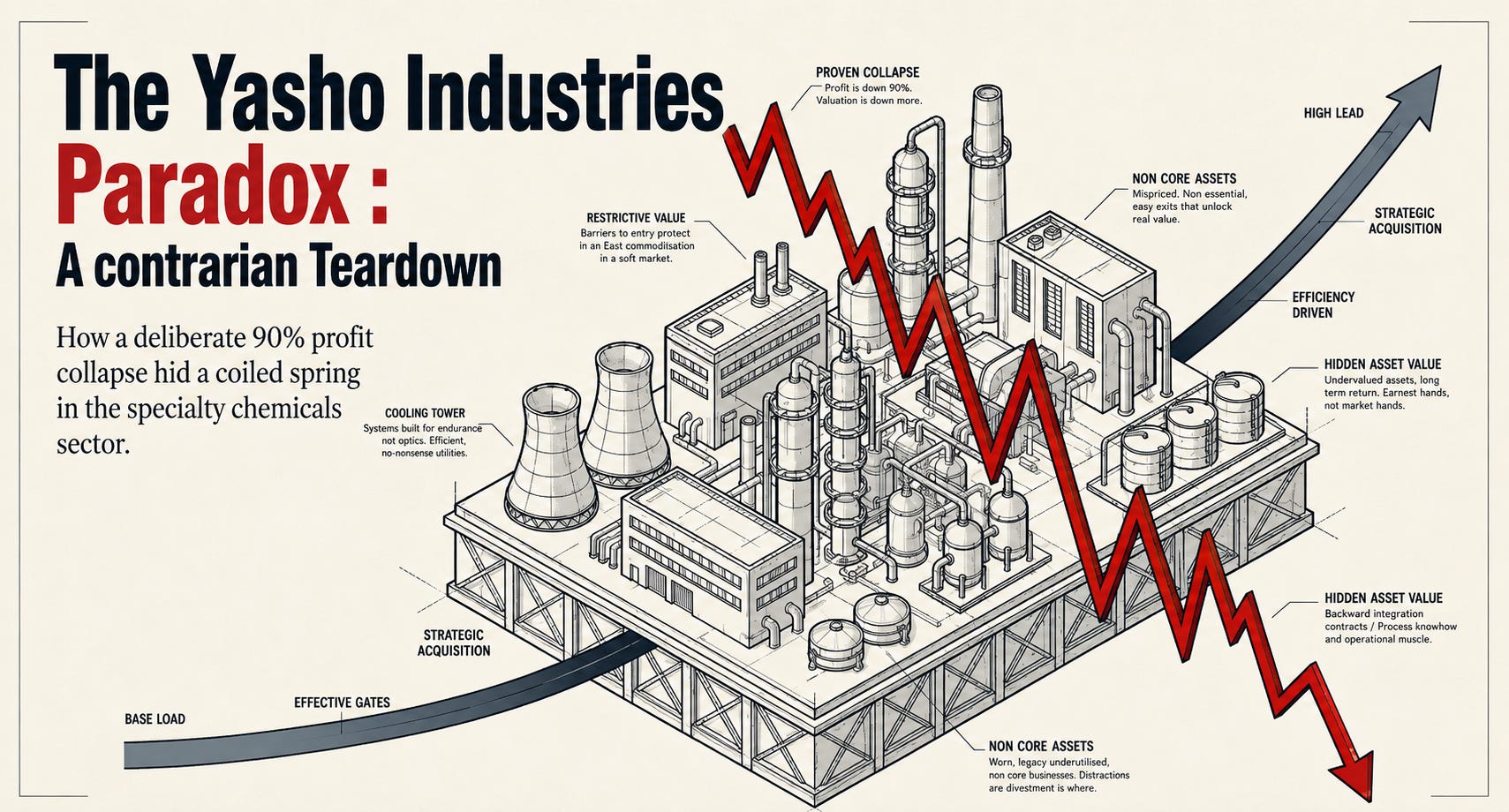
But look past the screener at the company’s most recent results, and you see something the headline numbers don’t show: the bet has started to pay off. In its latest quarter, profit came roaring back. The company earned more in that single quarter than in the entire year before it. Its debt burden nearly halved in the space of two quarters. And a marquee global multinational is voluntarily handing Yasho close to ₹98 crore in advance to help build its next factory, before a single product has shipped. That’s not what happens to a failing business. Nobody pre-pays crores to a supplier they’ve lost faith in.
So, we have two stories about the same company, sitting side by side. One is written in the trailing accounting numbers, and it still looks like decline. The other is written in the latest quarter, and in the behaviour of the people who actually buy from Yasho, and it looks like a turnaround catching fire.
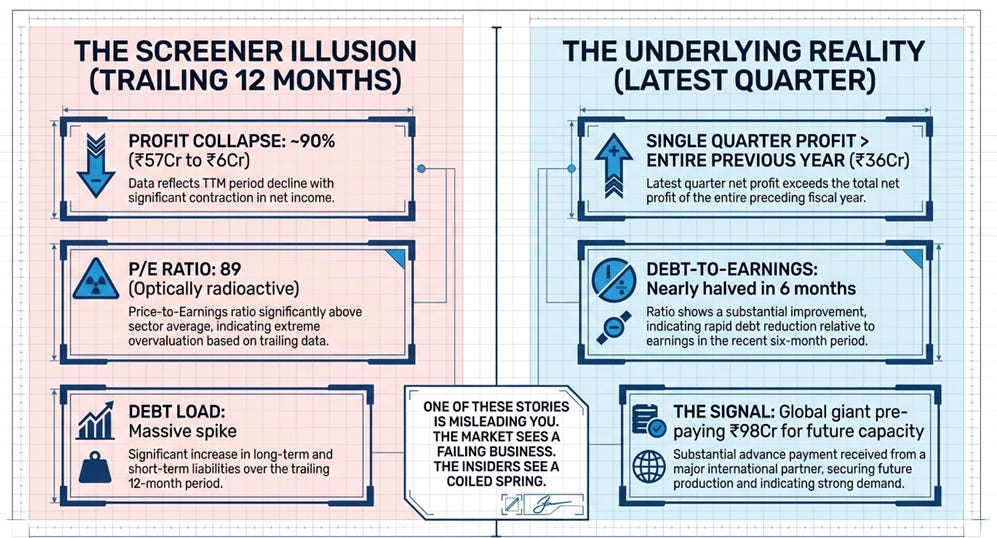
One of those stories is misleading. This entire piece is about figuring out which. And by the end, you’ll be able to answer it yourself, even if the word “chemicals” makes your eyes glaze over. Every bit of jargon gets explained in plain English the first time it shows up. No glossary needed.
But we can't judge a single number until we understand what this company actually makes and why anyone depends on it. So let's start there.
Chapter 1: The Invisible Company You Use Every Day
Here’s the simplest possible version.
Yasho makes ingredients. Not finished products, but the specialized ingredients that go into other companies’ finished products. It doesn’t make the tyre; it makes a chemical inside the tyre. It doesn’t make the perfume; it makes the molecule that gives the perfume its scent and holds it together. It doesn’t make the biscuit; it makes the additive that stops the biscuit going stale on the shelf.
You’ll never see Yasho’s name on anything. It sells you nothing directly. It lives one invisible layer behind brands you know perfectly well, and it counts more than 2,000 companies across 50-plus countries as customers.
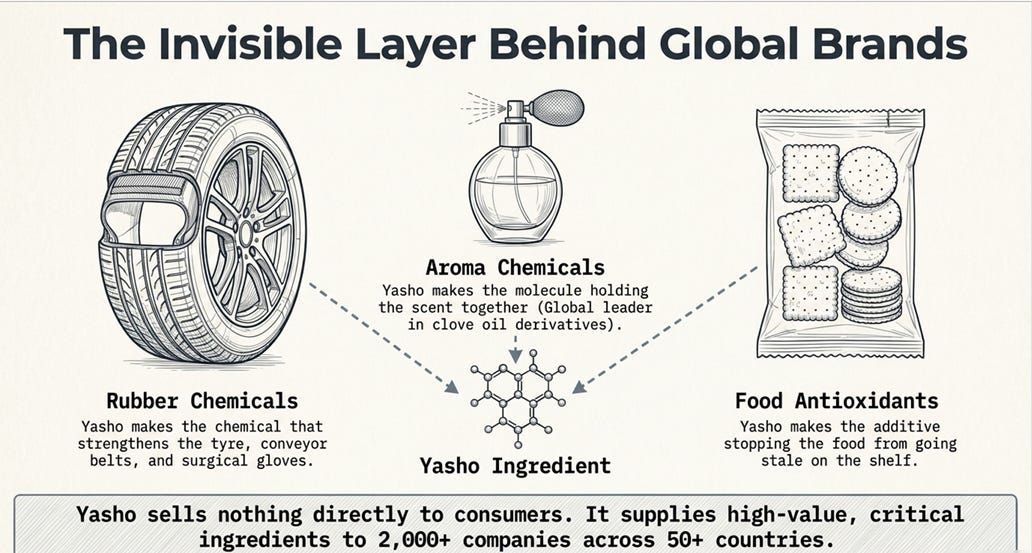
The one line worth memorizing is this: Yasho is a specialty chemicals manufacturer. That word “specialty” is doing enormous work, and it’s about to become the hinge the entire story swings on, so let me plant it now and pay it off in a few minutes.
For the moment, just hold onto this: Yasho makes complicated, high-value chemicals, not the cheap bulk stuff that any small operator with basic equipment can churn out.
A quick sketch of the company itself. It was founded by the Jhaveri family, incorporated back in 1985, with manufacturing kicking off in 1993. So it's a genuinely seasoned operator, four decades in, not a startup. It makes roughly 148 different chemical products and runs its manufacturing out of Gujarat, close to the ports it ships from.
Those 148 products spread across five families. Don't let the list intimidate you. Each one connects to something you already know:
Rubber Chemicals → go into tyres, conveyor belts, surgical gloves, condoms, balloons
Specialty Chemicals → stabilizers for paints, inks, resins, plus building blocks for medicines and crop chemicals
Lubricant Additives → make engine oils, hydraulic fluids, and greases perform better
Aroma Chemicals → go into perfumes, cosmetics, toothpaste (Yasho is a market leader in clove oil and its derivatives)
Food Antioxidants → the reason your biscuits and packaged food stay fresh instead of going rancid
Now here's the clean way to file all of that in your head. Those five families fold into just two divisions.
The Consumer Division covers Aroma Chemicals and Food Antioxidants.
The Industrial Division covers Rubber Chemicals, Specialty Chemicals, and Lubricant Additives.
So which way is management deliberately steering the ship? Toward Industrial. In the most recent quarter, the revenue split was roughly 89% Industrial, 11% Consumer, up from 87/13 a year earlier. That drift isn't random. It's a company quietly walking itself, quarter by quarter, into the room where the money is better.
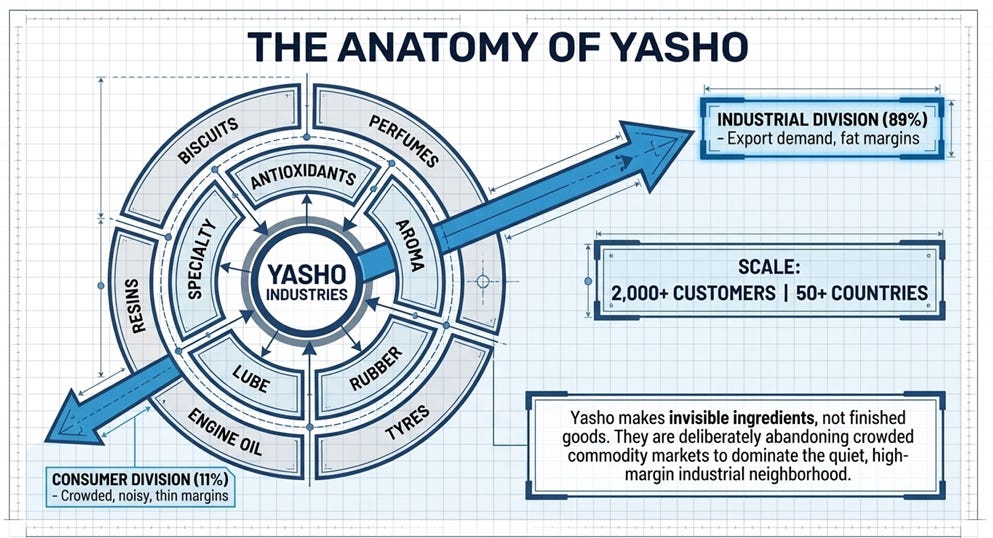
Already the picture is sharpening. This isn’t a random chemical maker throwing products at the wall. It’s a focused supplier deliberately climbing toward the higher-margin corner of its own industry.
But before we go further, I owe you that word I planted earlier, specialty, because it’s the single most important idea in this whole business, and almost nobody who dismisses “chemical stocks” understands it.
The two kinds of chemical company (and why only one is worth owning)
The market lumps every chemical maker into one scary, low-quality bucket: "cyclical, commodity, thin margin, at the mercy of raw material prices." And for a lot of them, that's fair. But there are actually two completely different animals here and telling them apart is the whole game.
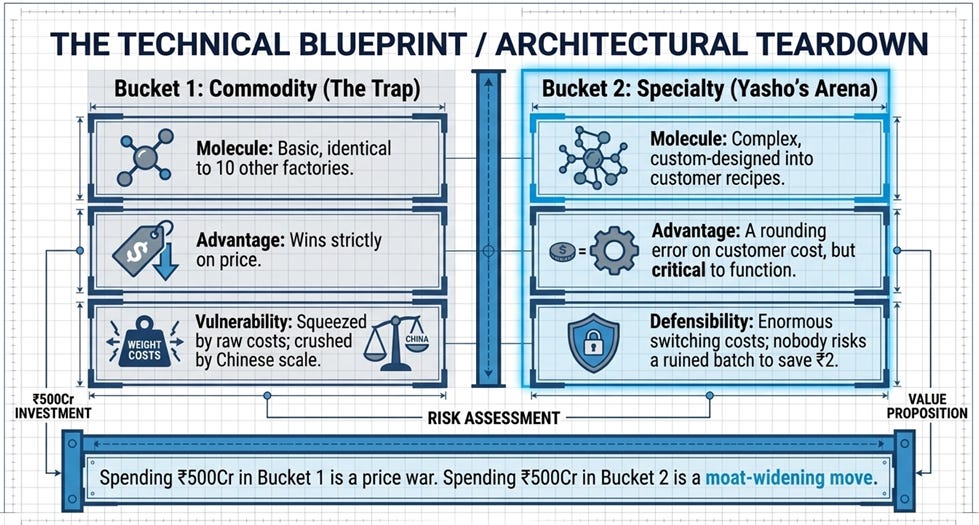
Bucket one: the commodity chemical maker.
It makes a basic chemical that’s identical to what ten other factories make. Its product is a number on a price list. The only way it wins an order is by being cheaper. When input costs rise, it gets squeezed. When a bigger, cheaper rival (usually Chinese) shows up, it gets crushed. This is the bucket the market is right to fear.
Bucket two: the specialty chemical maker.
It makes a specific, hard-to-replicate molecule that a customer has designed into their product. The customer doesn’t buy it because it’s cheap. They buy it because it works, and because ripping it out and re-testing a substitute would be a nightmare. And here’s the quiet magic of it: these specialty ingredients are usually a rounding error on the customer’s total bill, a rupee or two on a product that sells for hundreds yet breaking them wrecks the whole product. Tiny cost, total dependency. That’s the gap that hands the supplier real pricing power, fat and steady margins, and thin competition. Nobody switches suppliers to save two rupees when the downside is a ruined batch.
Yasho lives squarely in bucket two. And it’s deliberately moving even deeper into it. That’s what the 89%-Industrial drift is really about, and why management keeps pushing its 50-strong R&D team to invent complex new molecules rather than churn out more of the cheap stuff.
Here’s why this matters so much for what’s coming. In bucket one, spending ₹500 crore to build a giant new factory is terrifying; you’re just adding capacity to a price war. In bucket two, that same ₹500 crore is a moat-widening move: you’re building the scale to make hard molecules that few others can, for customers who can’t easily leave. Same spend. Completely different meaning. Hold that distinction, because it’s about to explain a decision that looks reckless on the surface.
Because that's what makes this company worth your next twenty minutes: a bet it made a few years ago that looks alarming at a glance, makes complete sense once you understand which bucket it's in, and in the process wrecked every number on that screener.
Let’s talk about the bet.
Quick pause before we go further. This kind of setup — a small-cap with real moats, a contrarian entry, and a clear growth trigger hiding behind ugly-looking numbers — is exactly what I look for. Every month I pick 2-3 quality businesses like this, take it completely apart, and share a 20-25 page deep-dive reports with a Small Private Community of serious investors. No tips, no price targets, just structured research. I'll tell you more about it at the end of this piece. For now, let's stay with Yasho.
Chapter 2: The Bet That Wrecked the Numbers on Purpose
So let's go back to that decision, the one that torched the profit on purpose, and see exactly what it was.
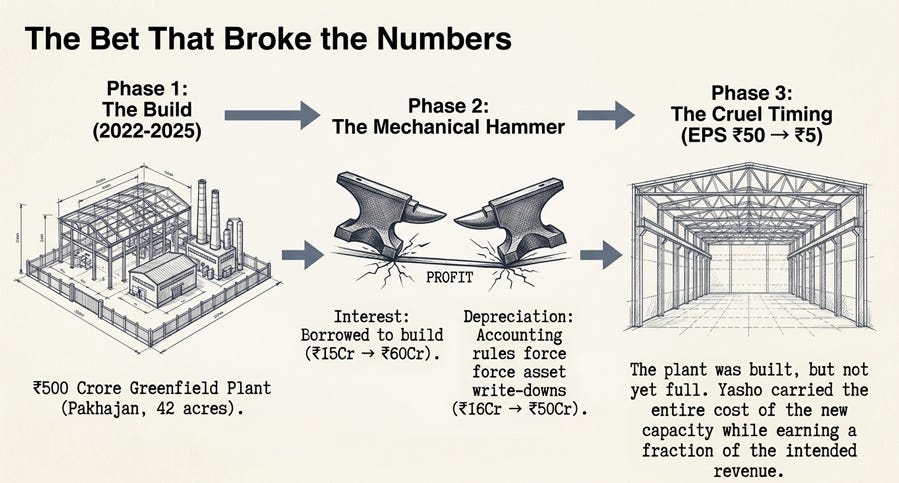
Between roughly 2022 and 2025, Yasho spent nearly ₹500 crore on capital expenditure, building new capacity, chiefly a brand-new greenfield plant in Pakhajan, in Dahej, Gujarat, spread across 42 acres. For a company doing a few hundred crore in revenue, that’s an enormous swing. It roughly supersized the entire manufacturing footprint in one move.
Here’s the mechanical reason a bet that size hammers your reported numbers, even when nothing is wrong. Two costs explode the moment the plant is finished.
First, interest. You borrowed to build it, so now you’re paying interest on all that debt. Yasho’s interest bill jumped from around ₹15 crore to roughly ₹60 crore.
Second, depreciation. A shiny new plant is a giant asset, and accounting rules force you to “depreciate” it, writing down a chunk of its value as an expense every single year, whether or not it’s producing anything yet. That charge climbed from about ₹16 crore to ₹50 crore.
And here’s the cruel timing that ties it together. The plant was built, but it wasn’t full. Customers don’t flood in overnight. So Yasho was carrying the entire cost of the new capacity while earning barely any of the revenue it was designed to produce. Roughly ₹57 crore of profit in FY24 became roughly ₹6 crore the next year, the tenfold fall we opened the article with, now with a cause attached to it.
And this is where the “expensive” screen comes from. Glance at Yasho today and the P/E looks eye-watering, up near 89, and new investors assume the stock is wildly overpriced. But look at what actually drives it. P/E is just Price divided by Earnings. When the “Earnings” at the bottom of that fraction get temporarily crushed, as they did here, by depreciation and interest on a plant that isn’t earning yet, the ratio mechanically balloons. Not because the business got expensive. Because the profit got temporarily flattened.
This happens to almost every company that finishes a large capex before the revenue arrives. It’s a normal, expected optical distortion, not a red flag, and it quietly reverses as the plant fills and earnings recover. We’ll come back to what the valuation really says later, with the rest of the financials, where it belongs. For now, just file away the reason the profit fell: a giant plant, paid for, not yet full.
David Dreman, the great contrarian, spent his whole career on one blunt observation: “People overreact.” They see a distorted number, they flee, and they never stop to ask what’s underneath it.
Underneath this one is a coiled spring. And the spring has a name. You need to understand it, because everything else in this story runs on it.
Chapter 3: The Coiled Spring Hiding Inside the Wreckage
This is the concept that turns a half-empty, cash-hungry plant into the most interesting thing about this company. So slow down with me here. It’s worth getting exactly right.
Think of the company’s costs as splitting into two piles.
One pile is fixed. It barely moves no matter how much Yasho sells. The interest on the debt. The depreciation on the plant. The factory that has to be lit, heated, and staffed whether it runs at 50% or 90%. Yasho just made this pile huge by finishing that ₹500 crore plant. This is the pile that crushed the profit.
The other pile is variable. It rises only when you actually make and sell more: the raw materials that go into each batch.
Now here’s the trick that makes this whole story move. When revenue climbs, only the variable pile grows with it. The fixed pile just… sits there. Already paid for. And because that giant fixed pile doesn’t grow, a huge slice of every new rupee of sales skips straight past the costs and lands in profit.
Let me make it concrete, because this is where it clicks.
Picture the factory today, running near half-full. It’s already paying, say, ₹110 crore a year in fixed costs (interest, depreciation, the lights, the people) whether it’s busy or idle. At half-utilization, revenue barely covers that weight, and profit is a thin sliver. That’s the ₹6 crore year. That’s the “scary EPS.”
Now fill the factory. Push utilization from 50% toward 85%. Revenue roughly doubles. But that ₹110 crore fixed pile? It doesn’t move. You’re not building a second plant. You’re not doubling the interest. You’re just running the machine you already own, harder. So the extra revenue arrives carrying almost no extra fixed cost, and it cascades down to the bottom line.
That’s why profit doesn’t rise in a gentle line as the plant fills. It lurches upward in a curve. Double the revenue, and profit can triple, quadruple, or more, because it was starting from a sliver, and the heaviest costs were already paid.
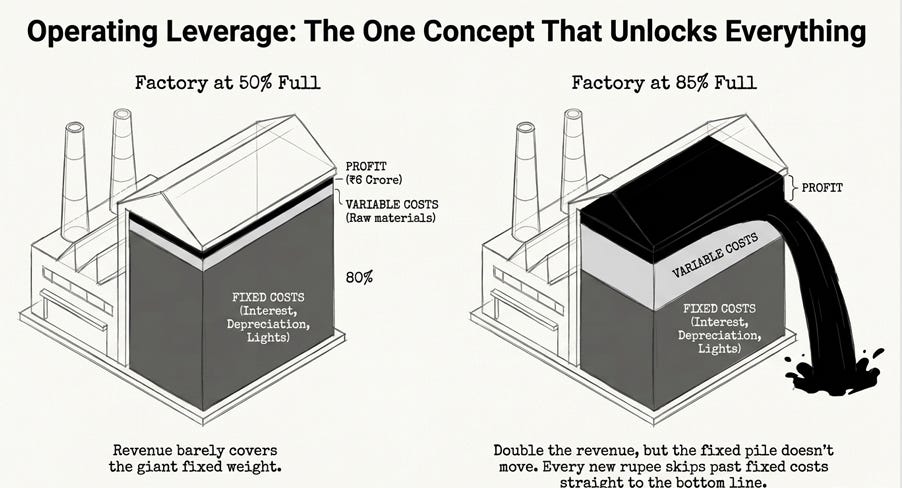
That is operating leverage. A business that pre-paid for its own growth, now waiting for the growth to show up and flood the bottom line. And Yasho is sitting directly on top of that coiled spring right now.
Charlie Munger had a line for exactly this kind of patience-testing setup: “The big money is not in the buying and the selling, but in the waiting.”
The plant is built. The costs are absorbed. Every ingredient is in place except one:
Will the factory fill up?
That single question is the investment. Nothing else matters as much. Hold onto it, because the latest numbers have started to answer it, and the answer is louder than the bears expected.
Let me pause here, because this is exactly the kind of setup my whole process is built to find.
I don’t chase tips or trade whatever’s hot. Over the years my approach has narrowed to five filters, and a business has to clear most of them before I’ll spend weeks tearing it apart. It has to be a small-cap, a market leader in its niche, sitting behind real moats, run by promoters with genuine skin in the game, and, most importantly, available at a contrarian entry point, where the crowd has misread the story and priced in fear instead of facts.
A collapsed EPS scaring people away from a company sitting on loaded operating leverage? That's the contrarian setup in its purest form. When a business clears all five filters, I take it completely apart and share that work with a Small Private Research community — delivered as structured research reports on a private Telegram channel, not tips, not calls. More on that at the end of this piece. For now, back to the factory.
More on how that works later at the end of the article. For now, back to the factory.
Chapter 4: The Spring Starts to Fire
When this story began, the Pakhajan plant was running at under 50% utilization. Half-empty. All cost, little output. That’s the “scary EPS” phase we just walked through, the bottom of the dip.
Now look at where things actually stand in the most recent quarter.
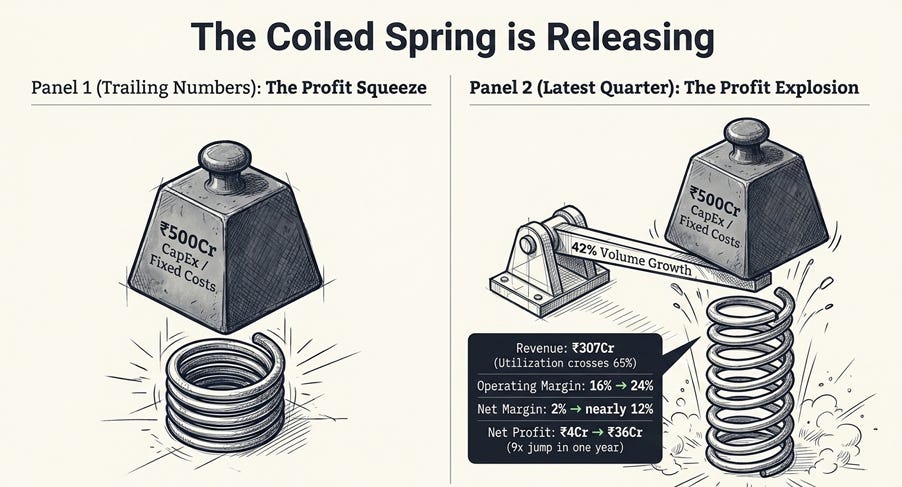
Capacity utilization has crossed 65%, and management says it’s still accelerating. Revenue for the single quarter came in at over ₹307 crore, powered by an eye-catching number: 42% year-on-year volume growth.
Read that phrase again, because it’s the tell that separates a real recovery from an accounting mirage. Volume growth. The company isn’t growing by quietly hiking prices. It’s growing by shipping more actual physical product out the door. More tonnes sold. That’s genuine, hard demand, exactly what you pray to see when a half-empty factory starts filling.
And the profit response? This is where operating leverage stops being a theory on a page and becomes something you can see, and where the “roaring back” line from the opening gets its actual numbers.
A year ago, in the same quarter, Yasho earned barely ₹4 crore of profit. This time, it earned ₹36 crore. EBITDA, a measure of core operating profit, leapt from around ₹33 crore to over ₹74 crore. The operating margin jumped from roughly 16% to over 24%. And look at what happened right at the bottom line: the net profit margin went from under 2% to nearly 12%. Same revenue engine, suddenly keeping six times as much of every rupee. Gross margins held strong above 42% throughout, which tells you the raw pricing power was always there. What changed was that the fixed costs finally had enough volume to spread across.
There it is. Revenue climbed hard, the fixed costs sat still, and the gap between them dropped through to profit. The spring is uncoiling in real time, right there in the numbers.
But a single good quarter can be luck. What tells you a story has genuinely turned is when the plumbing behind the scenes starts healing too. And it is.
Two numbers matter here more than any others.
Debt, measured against earnings, dropped from 3.75x to 1.86x in just two quarters. Remember, debt was the villain of this whole story, the thing inflating interest costs and crushing profit. When a company nearly halves that burden this fast, it’s telling you the earnings engine is finally strong enough to carry the weight it took on. The rating agencies noticed too: CRISIL and ICRA both upgraded Yasho’s credit rating from BBB+ to A-. That’s not cosmetic. A higher rating means the company can borrow more cheaply, which feeds straight back into profit. A quiet line in a filing; a real vote of confidence in the turn.
The working-capital cycle shrank from 190 days to 143 days. In plain English: cash that used to sit frozen, trapped in unsold inventory and unpaid customer bills, is now moving faster. For a business that had a genuine problem with bloated inventory in earlier quarters, this is the clogged pipe finally clearing.
And here’s the detail that tells you management believes its own story. Rather than sitting back now that the big plant is built, they’ve just raised the capex budget for the year, roughly doubling it, from ₹125 crore to ₹250 crore, to put up two new buildings at the Pakhajan site for products their R&D has developed. Crucially, they’ve said this is based on firm enquiries from international customers, and they’ll fund it while keeping debt-to-EBITDA below 2.5x. You don’t double your investment budget into a half-empty plant unless you can see the demand coming to fill it.
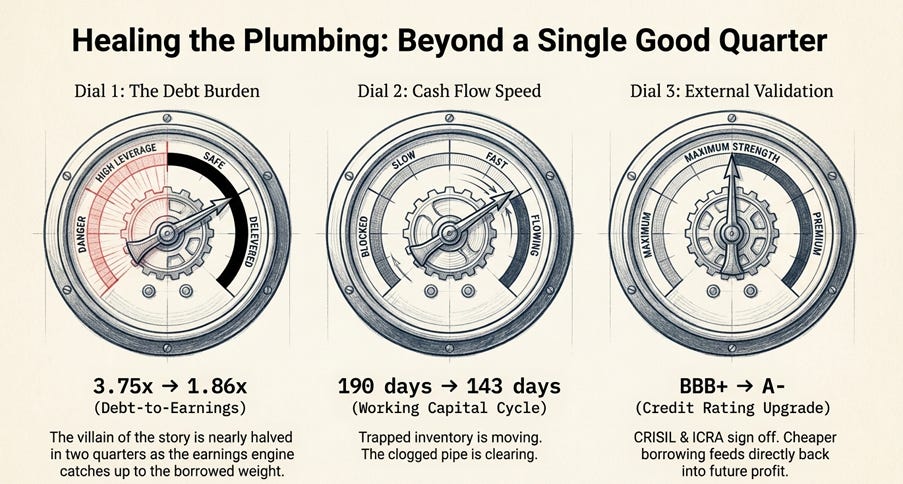
So the story that opened as “collapsed earnings” has quietly become something else entirely. Plant filling. Margins expanding. Debt falling. Cash freeing up. Credit rating upgraded. Fresh capex going in against real demand. Same company. Completely different chapter.
And management isn’t being coy about what they think comes next.
Here’s the line from the latest investor commentary that reframes the whole business. They’ve raised the FY28 revenue target to more than ₹1,600 crore and guided for 30-40% annual growth over the next two to three years.
Sit with that for a second. Today this is roughly an ₹800 crore business. Management is telling you it’s building toward double, and the factory to do it is already largely paid for.
But a target is just a target. Promising is easy. The honest question isn’t “is management right?” It’s the sharper one: what would have to be true for them to be right, and what could stop it?
That question is really a question about moats. Because a doubling only happens if competitors can’t simply walk in and steal the prize. So let’s ask the thing every skeptic should ask.
Chapter 5: The Five Walls Nobody Can Climb
Here’s the fair objection, and you should hold it in your mind the whole way through this section: “It’s a chemical company. Chemicals are commodities. What stops ten rivals from flooding in and crushing those juicy margins?”
It’s the single most important question in the entire analysis, and the answer is the reason Yasho is interesting rather than ordinary. It sits behind a set of walls that are genuinely, structurally hard to climb. Let’s walk them one at a time.
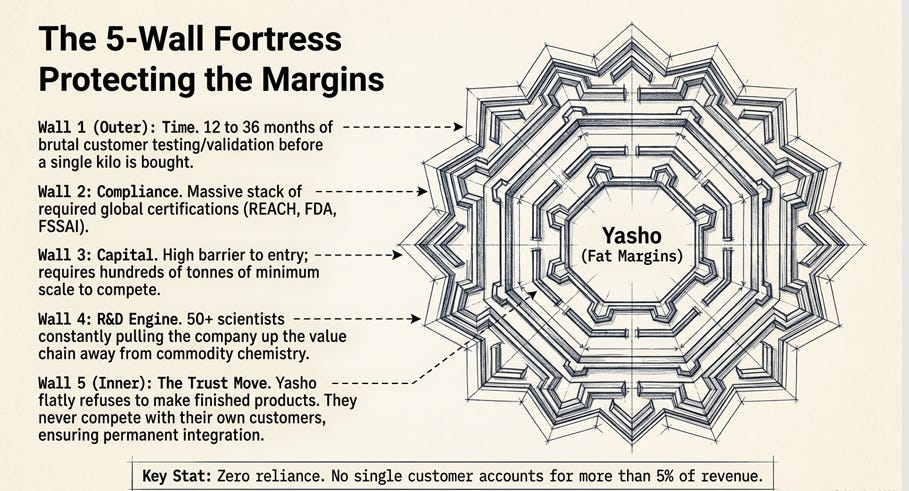
Wall 1 — Time. You’d think you could build a plant and start selling next month. You can’t. In this industry, before a serious industrial customer buys a single kilo from you, they run your product through a brutal approval process: testing, validating, and certifying that your chemical works flawlessly inside their product. For serious industrial and automotive customers, that qualification can take 12 to 36 months. Read that again. A new competitor could build a perfect factory and then wait up to three years, earning almost nothing, just to get approved. Most simply can’t survive the wait. The clock itself is a wall that kills weak entrants before they start.
Wall 2 — Compliance. To export to Europe, you need a registration called REACH. To sell food-grade chemicals, you need FSSAI and a stack of food-safety certifications. Yasho already holds a wall of them: ISO, FSSAI, NSF, Halal, Kosher, FSSC 22000, and more. Each one costs serious money and years of effort. A newcomer stares at that mountain before earning a single rupee.
Wall 3 — Capital. A small-batch chemical maker can start modestly. But Yasho operates at a minimum scale of hundreds to a thousand tonnes per molecule. Producing at that volume demands big, expensive infrastructure upfront. You can’t nibble your way in. You need real capital just to sit at the table.
Wall 4 — The R&D engine. Yasho runs a large in-house research facility with over 50 scientists. This is the machine that keeps dragging the company up the value chain, away from cheap commodity chemistry and toward complex, high-margin “performance chemicals” that rivals can’t easily replicate. This is how a company escapes the low-margin commodity trap: it out-innovates its way out.
Wall 5 — The trust move. This is my favourite, because it’s a choice, not just a capability. Yasho deliberately makes only pure chemicals. It flatly refuses to make finished products: no finished lubricants, no finished rubber goods. Why turn down that business? Because the moment you make finished products, you start competing with your own customers. By staying a pure ingredient supplier, Yasho becomes a partner its customers can trust completely, never a rival wearing a supplier’s coat. Once you’re approved into a customer’s recipe, and you pose zero threat to them, you become a permanent fixture in their supply chain. You don’t get swapped out.
Now stack all five walls together, and something clicks into place. It shows up in one clean, telling number.
No single customer accounts for more than about 5% of Yasho’s revenue. Over 2,000 clients, spread across 50-plus countries, with no single point of failure. Combine that spread with the approval walls, and you get a business that’s genuinely difficult to dislodge, which is precisely why it earns a fatter margin than commodity-heavy chemical peers.
Pulak Prasad, in What I Learned About Investing from Darwin, is almost obsessive about one thing: businesses that find a defensible niche and stay disciplined inside it. They don’t sprawl. They go deep and own their patch. Yasho reads like a page from that book. It doesn’t try to be everything. It masters a set of specialty chemistries and defends them.
And these walls aren’t a promise about some hazy future. They’re already built, already standing, already doing their job. Which brings us to a tailwind blowing at Yasho’s back that the whole world is suddenly talking about.
Before we go further, a slightly longer word about where work like this actually lives, because we’ve reached the exact point where a good story turns into something you could act on.
Everything you’ve read so far is the free version of how I think. It’s thorough by newsletter standards. But it’s still the surface.
I run a private research library called the Small Cap Research Club. It’s where I take businesses like this one and go 10 to 15 times deeper than any article can: full 20-to-25-page reports every month on carefully chosen small caps the market is mispricing. The kind of contrarian, beaten-down, time-sensitive setups where the thesis is intact but the price has been punished, and where I lay out precisely why the risk-to-reward is skewed in a patient owner’s favour.
Three things a public article structurally cannot give you, but a report can:
The concall deconstruction: what management actually signalled beneath the polished surface language, not just what they said.
A bull, base, and bear scenario: so you know exactly what you’re betting on under each outcome, not just the rosy one.
A quarterly tracking framework: the four or five specific numbers that quietly tell you whether the thesis is compounding or breaking, long before the crowd catches on.
Just this July, the I analyzed three names:
- a precision stainless-steel tubes leader riding a global capex wave
- a premium kitchen-and-homeware brand the market had soured on.
- and a lab-products company left for dead despite an intact business and heavy tailwinds
Note: The research is delivered on a private Telegram channel — but think of it less like a group and more like a personal research library. Every report is neatly archived, searchable, and accessible from day one — so you're not just getting future issues, you're getting the full collection the moment you join.
Just structured research for people who think in years. The names stay inside the Club. That’s the whole point.
Now, the tailwind.
Chapter 6: The Global Tailwind at Its Back
For years, the world’s chemical supply chain leaned heavily on one country: China. Cheap, massive, dominant. If you needed a specialty chemical made at scale, China was the default answer.
Then the ground shifted. Trade tensions. Supply disruptions during the pandemic. And a realization that spread through every multinational boardroom: depending on a single country for critical supply is dangerous.
Out of that fear was born a strategy now shorthand across global manufacturing: “China+1.” The idea is simple. Keep China, but add a reliable second source somewhere else. Every procurement head at every big multinational is now under quiet orders to find that “+1.”
And here’s where Yasho slots in like a key into a lock. Look at the three options a global buyer has:
Chinese suppliers: low cost, but now carrying real geopolitical risk.
Western suppliers (US/Europe): reliable, but expensive.
Yasho: cost-optimized, thanks to lower Indian operating costs, and reliable, with plants sitting near ports and a de-risked supply chain.
Yasho lands right in the sweet spot: cost-competitive against the West, dependable against China. In a world where every multinational is actively hunting for exactly this profile, that’s not a small edge.
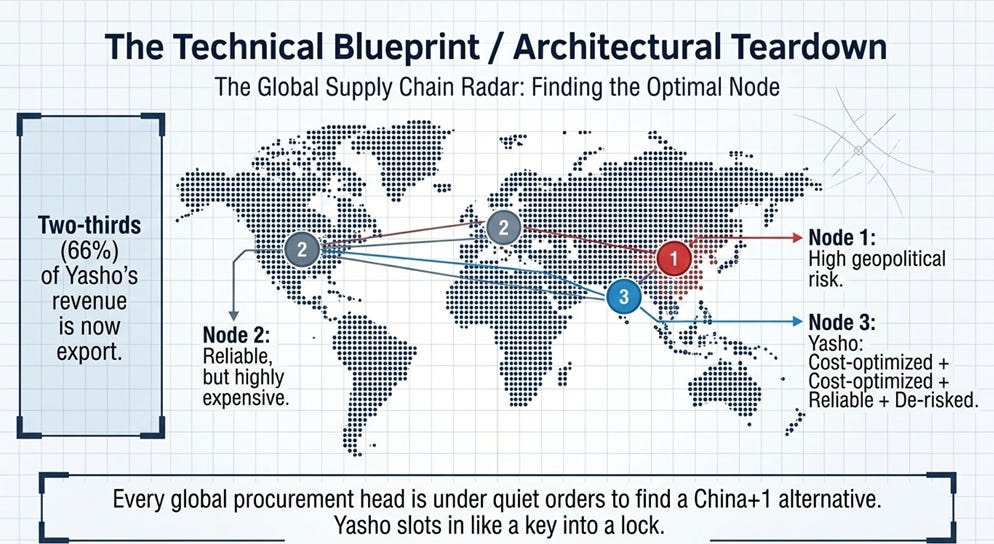
And you can see the strategy showing up in the actual numbers. Roughly two-thirds of Yasho’s revenue now comes from exports. When US demand wobbled on tariff uncertainty, management didn’t freeze; they pushed into fresh markets across South America, Africa, and Asia. In the short term, chasing new geographies can nick margins a little. In the long term, it makes the whole business far harder to knock over. No single country, no single customer, can sink the ship.
Now we can come back to that detail from the opening: the multinational pre-funding Yasho’s factory, the thing I said doesn’t happen to a failing business. You’ve now got the context to see exactly what it means.
The customer who paid to build the factory
Remember it: a marquee multinational pre-paying to help build one of Yasho’s new plants, with close to ₹98 crore in advances already in hand before commercial production begins. Up top, it was just an arresting number sitting next to a collapsing profit line. Now you can decode it.
Ask what has to be true for a customer to behave this way. They’ve found a specialized molecule they critically need. They’ve discovered that Yasho is one of the very few companies on earth that can make it reliably, at scale, to their standard. And they’ve concluded that the risk of not locking in that supply (a rival grabbing the capacity, or Yasho building too slowly) frightens them more than the risk of pre-paying for a factory they’ll never own.
That is not how anyone treats a commodity supplier. Nobody pre-funds a plant to secure something they could source from ten other places next week. This is how you treat a partner your own product depends on, one you cannot easily replace.
And the numbers around this contract show it’s real, not a slide. Of the roughly ₹98 crore received from the customer, Yasho has already passed about ₹71 crore straight through to its equipment vendors. The machines are being bought, not just talked about. Management has laid out a clear timeline you can actually track: equipment deliveries completing around Q3 of this financial year, trial production starting in Q4, and full commercial supply beginning around the first quarter of FY28. That’s a schedule with dates on it, which means it’s also a schedule you can hold management to.
Remember our two buckets? This is bucket two, specialty, hard-to-copy, real pricing power, captured in a single concrete transaction. Everything we just walked through in the moat section, compressed into one line of a disclosure. It’s the moat made visible.
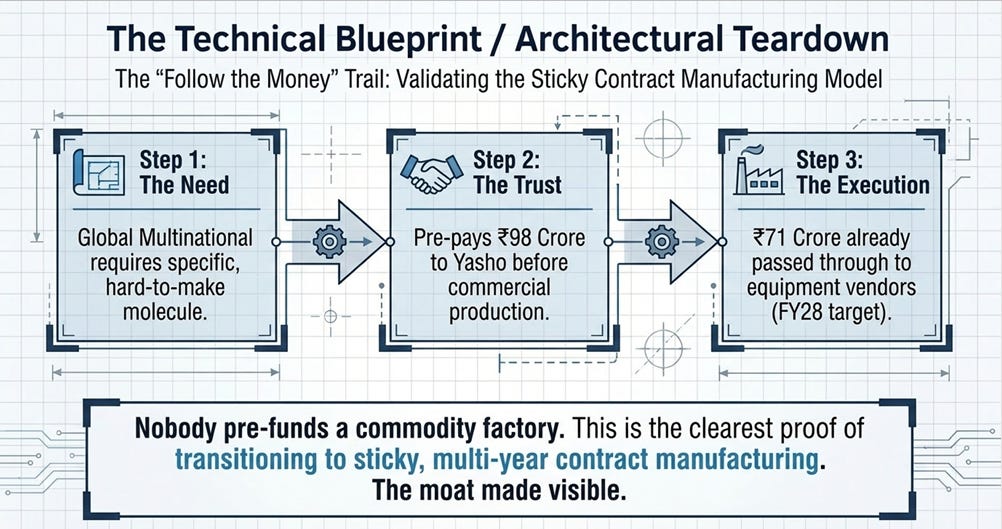
And it tells you where the whole business is heading. Yasho is shifting from “make chemicals, sell them to whoever shows up” toward long-term contract manufacturing for global giants, building specific molecules for specific customers under multi-year commitments. That changes the quality of the entire company: revenue you can see coming years in advance, relationships that are painful to exit, and earnings that deserve to be valued more highly than a commodity maker’s. A customer funding your capex isn’t just a helpful cheque. It’s the clearest proof there is that you’ve become hard to replace.
That said, this project commercializes around FY28. The cheque is in hand, but the revenue is still a couple of years out, and projects like this can slip. Which is the perfect moment to take off the cheerleader’s hat and put on the skeptic’s. Because no honest analysis is complete without the other side of the ledger.
Chapter 7: Now the Other Side — What Could Break It
If anyone ever tells you a stock is all upside, close the tab and walk away. Every genuine setup carries genuine risk, and Yasho’s are worth respecting, not to scare you, but to arm you.
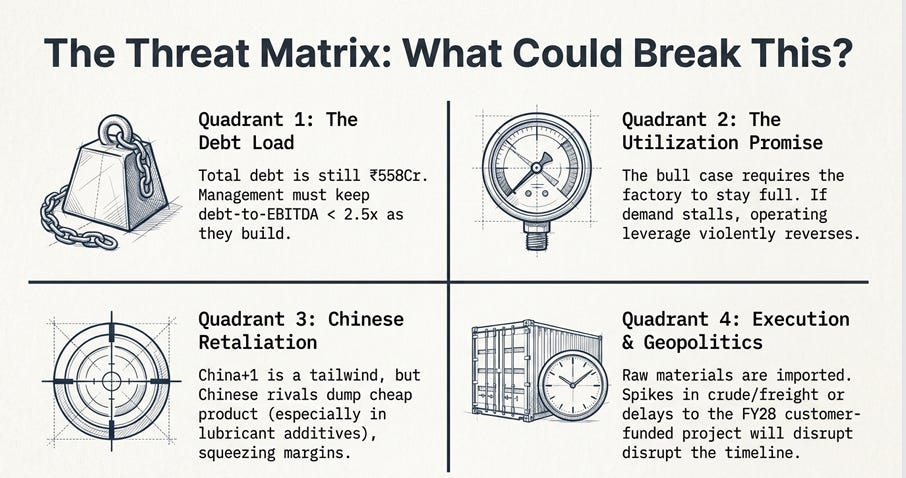
The debt is still real. Yes, the debt-to-earnings ratio fell beautifully. But total debt still sits above ₹550 crore. Management has committed to keeping it under control even as they spend on new capex. This is the number you watch every single quarter. If it starts creeping back up, the thesis is under strain.
Utilization is a promise, not a fact. The whole bull case rests on the factory filling and staying full. Management guides for it, and the early evidence looks good, but “guides for” isn’t “guaranteed.” Any stall in customer approvals or demand, and the operating-leverage magic runs in reverse, punishing profits just as fast as it lifted them.
China cuts both ways. China+1 is a tailwind. But Chinese manufacturers are also aggressive competitors, especially in lubricant additives, and management has openly admitted the competition there could get tough. If rivals dump cheap product, margins feel it.
Raw materials and geopolitics. Yasho imports a chunk of its raw materials, some from China. A spike in input prices, crude oil, or freight, from any fresh geopolitical shock, squeezes margins.
Execution timing. That customer-funded project commercializes around FY28. In projects like this, delays are always possible.
Howard Marks put it best: “Risk means more things can happen than will happen.” The job isn’t to pretend these risks don’t exist. It’s to weigh them honestly against what you’re being offered, and, crucially, to keep watching the specific numbers that would tell you the story is quietly changing
So how does it all net out? Let’s bring the whole thing home.
Chapter 8: The Verdict — Five Filters, Five Answers
This is where everything we’ve walked through gets weighed on one scale. My entire approach comes down to five questions. Let’s answer each, honestly.
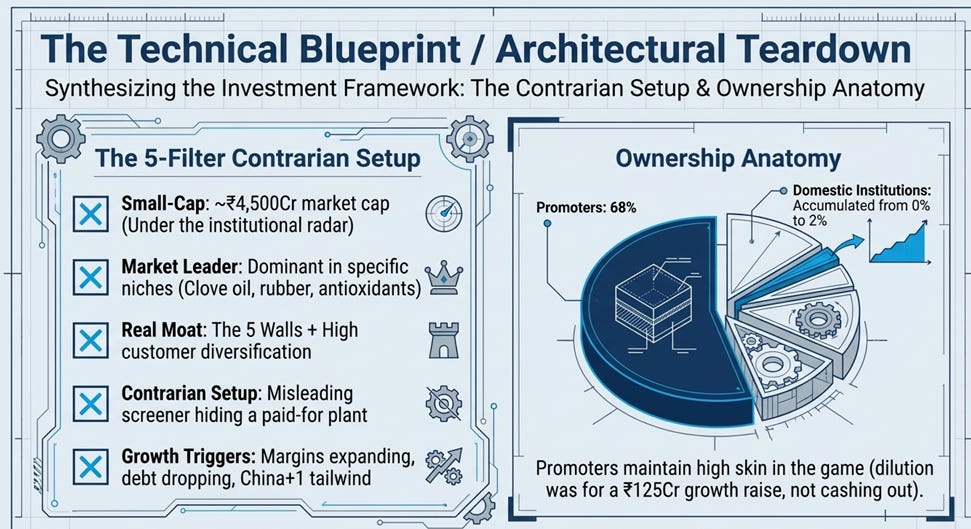
Is it a small cap? Yes. Market cap in the mid-four-thousands of crores, firmly in the territory where big institutions haven’t yet fully picked the name over, and where mispricing can still survive. Clear pass.
Is it a market leader? In its niches, yes. Market leader in clove oil derivatives, a strong specialist across rubber chemicals, lubricant additives, and food antioxidants, with 2,000+ clients and a deliberately defended position rather than a commodity free-for-all. Pass.
Does it have a real moat? This is the strongest leg of the whole thesis. Five stacked walls (the approval clock, the compliance mountain, the capital barrier, the R&D engine, and the non-compete trust structure) plus extreme customer diversification. This is a genuine moat, not a slide in a pitch deck. Strong pass.
Is there a contrarian angle? Yes, and it’s a clean one. On the surface, the recent numbers look weak: depressed returns, a big drop in profit, an optically high P/E, the kind of screen that makes most people scroll past. Underneath, a specialty maker sits on a paid-for plant with the operating-leverage spring wound tight and just starting to release. When the reported picture looks worse than the underlying reality, that gap is exactly where mispricing lives. Pass.
Are there identifiable growth triggers? Clear and stacked: rising utilization (50% → 65% and climbing), operating leverage flooding into profit, expanding margins, a raised ₹1,600 crore FY28 target, the shift toward high-margin industrial and contract manufacturing, the China+1 tailwind, and a falling debt burden. Concrete, trackable levers, not vague hope. Pass.
Five filters. Five passes. That’s genuinely rare; most companies I look at fail two or three instantly.
So here’s where the two stories from the opening finally meet.
The screener was telling you one thing: declining profits, ugly ratios, a business in trouble. The latest quarter was telling you something completely different: profit roaring back, debt falling fast, a global giant paying in advance to secure future supply.
Both were looking at the same company. The screener was measuring the cost of the bet. The latest quarter is the first glimpse of the return on it.
That multinational didn’t pre-fund a factory out of charity. It had figured out, from the inside as a buyer, exactly what we’ve just figured out the long way: this is a specialty supplier with real walls around it, a factory that’s paid for, and a business that’s just starting to deliver on a bet it made years ago. The advance cheque and the roaring-back quarter are the same story, just told from different seats.
Before we get to valuation, it’s worth spending a moment on who owns this company, because the shareholding pattern tells its own quiet story, and it lines up neatly with everything else.
What the Ownership Register is telling you
Start with the promoters, the Jhaveri family. They still hold roughly 68% of the company. That’s a lot of skin in the game; when management owns two-thirds of the business, their interests and yours are pointed in the same direction. But there’s a subtlety worth noticing: that stake has actually come down over the past year, from around 72%. Normally, promoters trimming their holding is a yellow flag. Here, it isn’t. The dilution came from a ₹125 crore preferential allotment, a deliberate raising of fresh capital to help fund exactly the growth we’ve been discussing. In other words, the promoters didn’t cash out; they brought in money to build. That’s a very different thing.
Now look at who’s been buying as the promoters diluted. Two groups stand out. Foreign institutions (FIIs) have built a position from almost nothing to around 5-6%, anchored by Malabar. And domestic institutions (DIIs), mutual funds and the like, have gone from essentially zero to over 2% in the space of a year. That’s the sharpest change on the whole register. When domestic funds move from completely absent to steadily accumulating, it usually means the professional money is starting to do the work on a name the broader market hasn’t noticed yet.
And the retail picture fits the same theme. The total number of individual shareholders has actually shrunk over the past year. That sounds bad until you think about what it means: the stock hasn’t yet become a crowded retail favourite. It’s still flying under the radar, which, more often than not, is precisely when a story like this is still early, before the crowd arrives and the easy attention gets priced in.
So the ownership map reads cleanly: committed promoters raising capital to grow, institutions quietly accumulating, retail not yet piled in. None of that is a reason to buy anything. But it’s a coherent picture, and it rhymes with the operational story rather than contradicting it.
One last footnote, and I want to keep it exactly that, a footnote. A couple of well-regarded investors, including Ashish Kacholia (who’s held the name since 2021) and Malabar India Fund (which entered in 2025), sit on that register. I mention it only as mild validation that the setup isn’t obviously crazy, not as a reason to act. Their presence proves nothing about the future, and Kacholia has in fact recently trimmed a sliver of his stake. The conviction in this piece comes from the walls, the operating leverage, and the numbers we walked through, not from whose name is on the shareholding list. Borrowed conviction is the weakest kind there is.
Which leaves one honest loose end: the valuation. If the business is this good, is the stock already too expensive to matter?
Chapter 9: The Number Everyone Gets Wrong
Time to be precise about what the valuation actually says, without a single word about share price, and without any buy-or-sell verdict. This is education, not advice.
Start with that scary-looking P/E near 89, because it trips up almost everyone. As we saw earlier, it’s built on temporarily collapsed trailing earnings, profit crushed by the depreciation and interest on a freshly finished plant that isn’t earning yet. As the plant fills and profit recovers, the “E” rebuilds and that ratio comes down on its own. Look at how fast it’s already moving: this is a company that earned ₹36 crore of profit in a single recent quarter, against roughly ₹25 crore for the entire prior year. The trailing P/E is looking backwards at the worst of the dip. So on its own, it tells you almost nothing useful. It’s the most misleading number on the screen.
But here’s the discipline that separates thinking from cheerleading: I won’t pretend the other numbers are cheap. Let’s put the real figures on the table rather than hand-wave. Yasho trades at roughly 10.5 times book value, about 5 times sales, and near 29 times EV/EBITDA. None of those is a bargain multiple; each one says the market is already paying up for a good business, not ignoring a cheap one. And the return ratios look weak on the surface, ROCE around 8%, ROE around 5%, numbers that would normally make a quality-focused investor walk away.
Here’s the crucial part, though: those return ratios are depressed for the exact same reason the EPS collapsed. ROCE and ROE are profit divided by the capital (or equity) in the business. Yasho just stuffed ₹500 crore of fresh plant into the denominator while the profit in the numerator is still suppressed by a half-empty factory. Big denominator, small numerator, tiny ratio. As the plant fills and profit climbs against that same capital base, both ratios mechanically rise. It’s the same operating-leverage effect, viewed through a different lens. The PEG ratio, meanwhile, prints negative, which is simply meaningless here, because the trailing earnings it’s built on are distorted. Blunt ratios fail on a company caught mid-transition. That’s not a flaw in the company; it’s a flaw in the tool.
So here’s the honest framing, undressed. The bull case is not “this is statistically cheap today”; it plainly isn’t. The bull case is: “today’s ugly ratios are distorted by a completed investment cycle, and the real question is whether earnings normalize the way management is guiding.” If they do, that 8% ROCE and inflated P/E reset toward something far healthier. If they don’t, you’re paying a premium multiple for a mid-size chemical maker still carrying around ₹558 crore of debt.
So what exactly are they guiding? Let’s put the forward case on the table with actual numbers, not vague hope.
Management has set a target of EBITDA margins above 20% by FY28 as utilization improves and the product mix shifts further toward high-margin industrial chemicals. Here’s the part that should catch your attention: Q1 FY27 already delivered a 24.18% EBITDA margin — the company has in fact exceeded that target in the latest quarter, and it’s still only at 65% utilization. When the plant pushes toward the 85-90% that management is guiding for, the numbers above 20% could become structural rather than episodic.
Then there’s the MNC contract, which the article has already established as the clearest proof of the moat. What the notes add is a dimension we haven’t mentioned yet: this is a 15-year supply agreement, and once at full commercial supply, management expects it to contribute around ₹150 crore in annual revenue on its own. That single contract, from a standing start of zero, adds roughly 18% to today’s entire annual revenue base. One relationship, locked in for a decade and a half.
And here’s an efficiency number that almost nobody talks about when discussing Yasho’s growth story: management has flagged a 4:1 revenue-to-capex ratio for incremental investments at Pakhajan. In plain terms, every ₹1 crore of additional capex at the site is expected to generate ₹4 crore of additional revenue. That’s not a marginal return on a mature business — that’s the math of a half-utilized plant where the infrastructure cost has already been sunk and fresh production lines are cheap to add.
Put all three together — the margin trajectory, the 15-year contract revenue, and the 4:1 efficiency ratio — and the forward picture looks very different from the trailing screener. That’s the gap this entire chapter is about.
That tension, between a distorted present and a well-supported forward case, is the entire investment debate. You don’t settle it with one number on a screen. You settle it by watching, quarter after quarter, whether the factory really fills, whether the debt really keeps falling, whether the margins really hold. Which is precisely the kind of work that doesn’t fit inside a public article.
Chapter 10: The Full Picture, Assembled
Let’s zoom out one last time.
Yasho Industries is a business standing at a genuine inflection point. It made a big bet, took the pain, watched its reported numbers turn ugly, and is now, quarter by quarter, showing the early evidence that the bet is paying off. Utilization climbing. Margins expanding. Debt falling. Rating upgraded. Ambition doubled. It sits behind real walls and rides a real global tailwind.
It is also, undeniably, a high-risk, high-reward story whose whole future rests on one word: execution. If the factory fills and the contracts land, this business could look dramatically different in a few years. If execution stalls, it remains a mid-size chemical maker carrying a real debt load. Both outcomes are live.
That’s the honest, complete picture. No hype. No price target. No call.
But notice how far you’ve come. We started with a puzzle: a management team that chose to blow up its own profits, and a screener that still calls the result a disaster even as the latest quarter tells the opposite story. You now know which story was misleading, and why. You understand why those reported numbers cratered on purpose, what the company is quietly building behind them, how its moats protect it, and which risks would break the story. That’s the entire point of doing this work: not to be told what to do, but to be equipped to decide for yourself.
There’s a particular kind of business that looks its ugliest on a screen at the precise moment it’s getting interesting, where the surface numbers say “stay away” exactly when the underlying business is turning a corner. The whole skill, the entire job really, is telling the genuinely broken companies apart from the ones that are merely mid-transformation and misread.
That’s hard. It takes work most people won’t do. But it’s where the interesting things hide.
If you feel you have gotten a great insight into how to look at contrarian setups - do like this article, share it with your investor friends and restack this to show support. If you want a more structured approach to stock picking and research do continue reading.
Where the deeper work lives
If you made it all the way here, you’re not a tourist. You’re a serious student of businesses. This last part is for you.
Over the past hour, we’ve taken apart a specialty chemical company’s business model, decoded a deliberate profit collapse, explained the operating leverage mechanics, mapped the moat, decoded the latest concall, and read the valuation honestly. That’s the free version of how I think — and it’s thorough.
But there’s a layer this article structurally cannot reach. And that’s where the Small Cap Research Club comes in.
The article and the report are not the same thing at two different sizes. They answer two different questions.
This article answered: What is this business, and why does it matter? The full story — the model, the moat, the profit collapse explained, the growth triggers, an honest read on valuation. You finish it understanding the business.
The Small Cap Research Club answers a different question: Does this thesis hold up under deeper scrutiny — and what specific signals would tell you if it's playing out or breaking down?
One thing worth being clear about before you join. Reading this article does not mean you’ll get a Club report on Yasho. The Small Cap Research Club is not a “deeper version of whatever I just wrote about on Substack.” It works differently.
The ideas I share in the Club are specifically chosen because they have visible triggers, favourable risk-to-reward, and visible growth triggers happening right now. Some businesses I cover on Substack will qualify — when the timing is right. Others I might return to in a later quarter when valuations become more interesting or a strong growth trigger has just materialised. The question the Club answers isn’t “is this a good business?” — it’s “is this worth looking at this month, at these levels, with these triggers in play?”
That distinction matters. It keeps the research focused and the ideas time-relevant rather than just intellectually interesting.
Here’s exactly what members receive:
2–3 company deep-dives per month (20–25 pages each) — a fully researched teardown on a carefully selected small-cap where the risk-reward is compelling right now. Each report includes a concall deconstruction, bull/base/bear scenario mapping, and a quarterly tracking framework with the specific numbers that will tell you if the thesis is working
Sector studies every couple of months — a full sector deep-dive covering the value chain, where capital cycle opportunities are forming, which segments are overcrowded and which are ignored, and a watchlist of names worth watching
Curated pipeline notes — short research observations on businesses I’m studying but haven’t yet written up, so you can start your own thinking early
Email Q&A access — write in with questions on anything published and I respond personally
Delivered and archived on a private Telegram channel — not a chatroom, not a tips group. Think of it as a well-organised research library that lives on Telegram. Every report, sector study, and pipeline note is neatly arranged by category and permanently accessible. New members get the full archive from day one — not just future issues, but everything published since the Club started. You can search it, revisit old teardowns, and build up a reference library over time
What the Club is not:
Not a tips group. No “buy this today,” no target prices, no exit calls
Not a Yasho deep-dive waiting to happen — ideas are chosen on current merit, not because of this article
Not personalised portfolio advice
What’s already on the shelf:
April: textile sector deep-dive
May: pharma sector deep-dive with 12+ watchlist names
June: deep dives on a fast-growing diagnostics chain and a specialty pharma player
July: teardowns of a precision stainless-tubes leader, a premium homeware exporter, and a beaten-down lab-products maker
Coming shortly this month: a deep-dive on a much-loved packaged-foods and biscuits brand, with a layered valuation reveal, full concall dissection, and the quarterly tracking framework — going deeper than even this article did.
If this article gave you a new way to look at a business, the Club is where that thinking goes deeper, more regularly, and with the specificity to actually act on it.
We’re have crossed 2,500 Substack members. A big thank you for that. To mark this event, I’m opening a discount for first 50 enrollments. Use code ROHIT20 for 20% off on the annual membership (valid for the next 4 days)
Thank you for sitting with this piece. In a world of fifteen-second takes and one-line stock tips, spending this much time on a single business is rare — and it’s exactly the kind of thinking that compounds over time. If it helped you see this business more clearly, the best compliment you can pay me is to hit like and share it with one person who invests the way you want to. Also Restack it show support. It tells me to keep making these
Disclaimer - Educational content only. Not investment advice. The author is not a SEBI-registered Investment Adviser or Research Analyst. Nothing here is a recommendation to buy, sell, or hold any security. All figures are drawn from public disclosures: the company's investor presentation, earnings commentary, and Screener data. Historical performance is not indicative of future results. This article discusses no target prices and makes no return projections. Please do your own due diligence and consult a SEBI-registered adviser before any investment decision.